Staying Relaxed When Life Gets Demanding

What Qigong can teach us about tension, anticipation and unnecessary effort.
Exploring internal force, anticipation and unnecessary effort through Qigong.
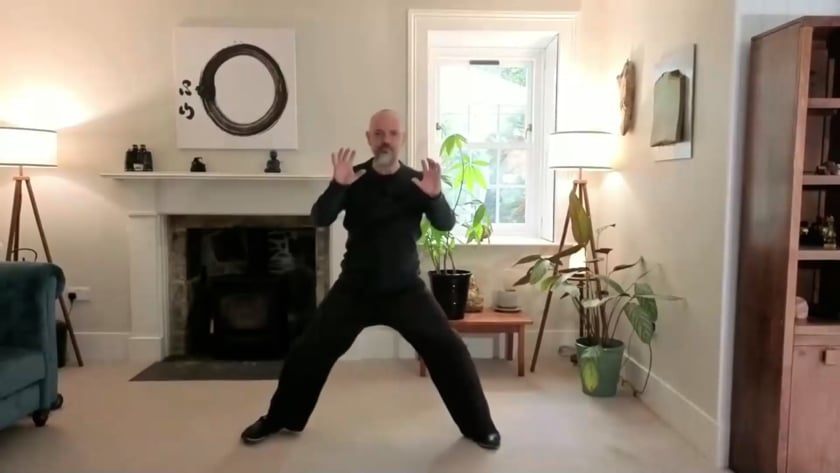
In this morning's Qigong class, we explored three exercises from the 18 Lohan Hands: Drawing Sabres, Green Dragon Presents Claws, and Pushing Mountains.
Although each exercise has its own particular qualities, they share some important principles. Through changes in posture, movement, intention, and how we use our bodies, we can explore different expressions of internal force.
One exercise in particular, Green Dragon Presents Claws, brought something interesting into focus.
What happens when things become demanding?
Green Dragon Presents Claws involves turning, coiling and lengthening through the body. We work with our stance, spine rotation, and connection through the arms and legs.
As the movement becomes more physically demanding, we may notice ourselves tightening.
Perhaps the shoulders tense, the jaw becomes tense, or we start trying to hold the body in position through muscular effort.
Sometimes this happens in response to the physical demand itself.
But sometimes something more subtle occurs.
The mind anticipates the difficulty, and the body begins to tighten before we have even encountered it.
We are no longer simply responding to what is happening. We are responding to what we imagine might happen.
Relaxation is not the opposite of strength.
In Qigong, relaxation is an important skill, but it's easy to misunderstand.
We are not trying to become limp, passive or incapable of effort.
Instead, we are learning to recognise the difference between the effort that is needed and the effort we unnecessarily add.
We can remain upright, connected and strong without deliberately tightening every muscle to hold ourselves together.
In our internal force training, this becomes a particularly interesting exploration.
Can the body remain supported through its structure, connectedness and energy, rather than relying entirely on conscious muscular effort?
Can we allow the movement to unfold without trying to control every part of it?
And can we remain relaxed even when the physical demands increase?
Taking the practice into everyday life
Of course, this doesn't happen only during Qigong.
When we encounter a difficult conversation, an unexpected problem or something we feel uncertain about, we may notice a similar response.
The body tightens. The mind begins anticipating what might happen next. We prepare ourselves, sometimes for difficulties that haven't yet arrived.
We might even carry this tension long after the situation has passed.
Qigong offers an opportunity to recognise these habits in a relatively simple, safe environment.
We can notice ourselves tightening, without immediately needing to correct it.
Sometimes that awareness is enough for something to begin changing.
Other times, we may consciously soften, adjust our posture, or let the breath settle.
The important thing is to recognise the difference between meeting a challenge and bracing against it unnecessarily.
What if we feel the movements will be too difficult?
Sometimes this process begins before we've even started.
People considering learning Tai Chi or Qigong may look at the movements and wonder whether they are flexible enough, have enough balance, or can remember what to do.
We can find ourselves anticipating difficulty before we've even experienced it.
And that anticipation may become another form of holding.
Yet we don't need to arrive at a Qigong class already knowing how to relax, move gracefully or maintain our balance. These are some of the very things we come to explore.
The movements can be adapted to our abilities, whether sitting or standing, and we can gradually discover what becomes possible.
We don't need to force ourselves into positions or movements that aren't available to us yet.
Perhaps the more interesting question isn't whether we can perform the movement correctly, but what we discover about ourselves as we begin to explore it.
We don't need to be good at Qigong to begin practising Qigong.
Sometimes, simply allowing ourselves to be beginners is the first chance to practise letting go of unnecessary effort.
A different relationship with effort
Perhaps one of Qigong's deeper benefits is not simply learning to relax when life is peaceful.
It is developing the capacity to remain appropriately relaxed when life becomes demanding.
This doesn't mean that we never need to exert ourselves, make decisions or take action.
It means we may discover ways to do these things without adding so much unnecessary effort.
And perhaps, as we cultivate inner strength, we begin to see that strength and relaxation aren't necessarily opposites.
Sometimes they support one another.
A question for your own exploration:
The next time something becomes challenging, can you notice whether you are responding to what is actually happening, or already tightening in anticipation of what might happen?