Archive for September 2026
What happens when we stop holding?
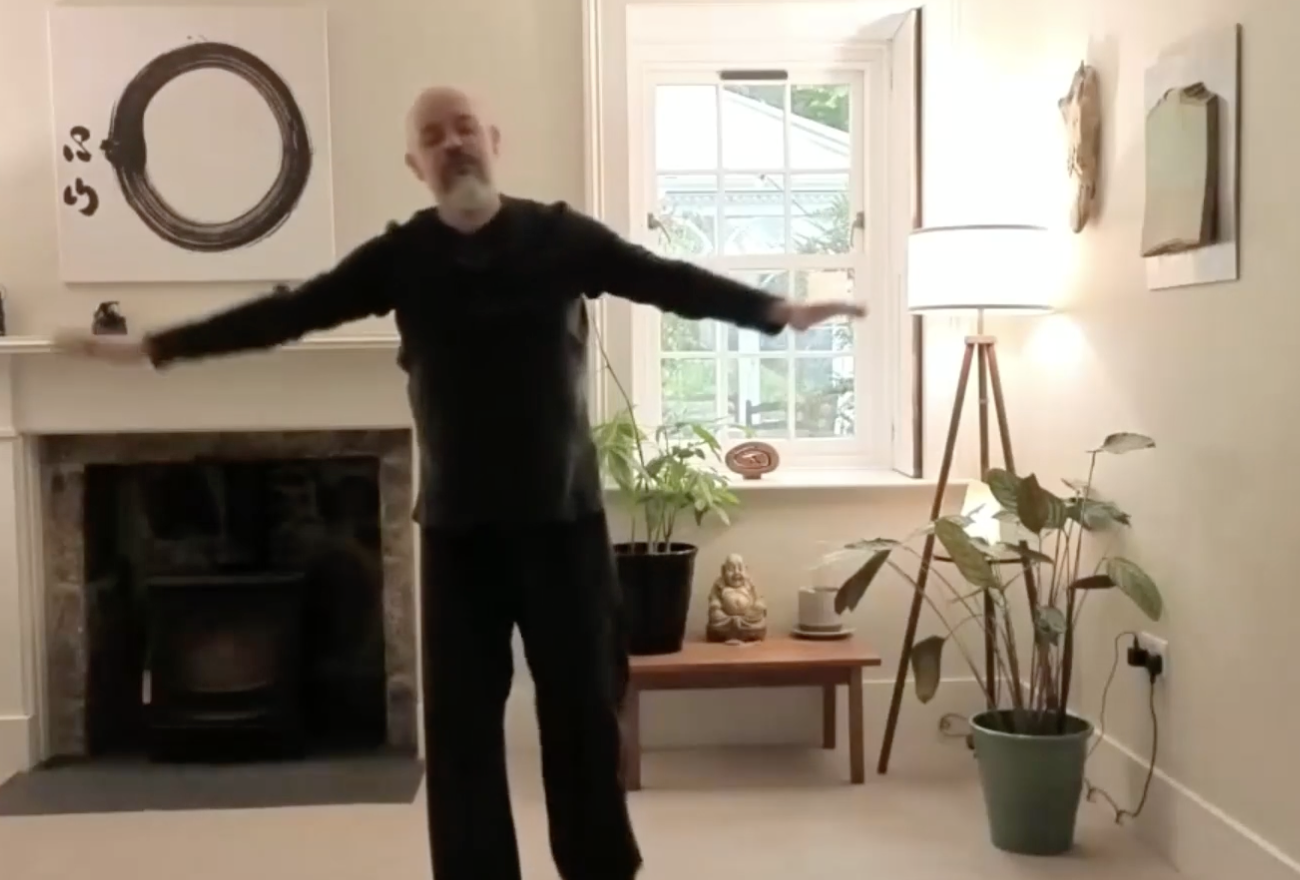
Maria asked about how her injured shoulder can sometimes move during Qi Flow in ways that don't seem available to her ordinarily.
When we've had an injury, there can be an unconscious guarding around it. The body protects the area, and this can involve holding tension. That efforting can remain for quite a long time, particularly if an injury or discomfort is still present. It may be very subtle, but maintaining that protection uses energy.
When Qi begins to flow freely, something different can happen. Rather than us moving the body in order to move the energy, the energy becomes the vehicle of the movement.
In other words, rather than you moving to try to move energy, energy moves you.
It is a little like the wind moving a tree. The tree isn't trying to move the wind.
Sometimes movement then becomes available that didn't seem available moments before. From a Qigong perspective, we might say that the Qi is flowing more freely through that area. At the same time, the mind-body relationship that has been doing the holding may have relaxed enough that there is less need to brace or protect.
Maria then asked, "What is the function of the brain here?"
That's a huge question, but we can think about it quite simply.
When there is pain or injury, part of our attention can become focused on the injured area. There is a conversation going on between the brain, nervous system, muscles and the rest of the body. If the underlying message is, I need to be careful here, the body may respond by holding a little tighter and restricting movement.
In a sense the body is saying:
Don't worry, I've got you. I'll hold you a little tighter so that you don't injure yourself again.
That's useful. It's protective.
But sometimes that protective pattern continues beyond the moment in which it was originally needed.
In Qigong we enter a Qigong state of mind and gradually stop interfering quite so much. In Flowingly Still, the mind or Shen becomes clearer. In Flowing Breeze Swaying Willows, the body becomes freer. As we move into Flowing Stream Floating Clouds, Qi increasingly becomes the vehicle of the movement. We aren't consciously deciding where every part of the body should go.
And this can develop into Self-Manifested Qi Movement, where we let go even further and allow the Qi to flow where it needs to flow.
Eventually we return again towards Flowingly Still and Standing Meditation.
The interesting thing is that the Qi hasn't stopped flowing simply because the body has become still. There can be a considerable flow of energy with very little outward movement.
This is one reason Flowingly Still can be such a powerful practice for cultivating internal force. Rather than the energy being expressed through larger physical movement, it can nurture and nourish. We cultivate not only the amount of energy available to us, but also its quality, while the mind and spirit become clearer.
So the different levels of Qi Flow are not simply different amounts of physical movement. They give us different ways of working with energy, body and mind.
And perhaps the simplest way of knowing what has happened is the question I asked Maria afterwards:
How do you feel?
"Much lighter," she said.
And then she noticed something else.
The silence in the mind remained.
Entering a Qigong State of Mind is Not What You Think
“Don't go into a Qigong state of mind.”
It was a slightly strange way to begin this morning's class, particularly as some of the people standing there have been practising with me for years. Stand in Wuji and something already knows what to do. The eyes close, the breath settles, and before long we have moved into that familiar place we call a Qigong state of mind.
So this morning I asked everyone not to.
Keep your eyes open for a moment. Don't regulate the breath. Just notice.
It is quite hard, actually.
Because after a while these things become familiar, and Wuji itself can become a sort of signal. We stand there and something shifts. We move from the part of ourselves that has been thinking about the morning, what we have to do next, whether we've had breakfast, whether we've had coffee yet, into something else.
And I became curious about that something else.
Not so much what a Qigong state of mind is. I'm not sure I particularly want to define it. More, what changes when we enter it?
Because something does.

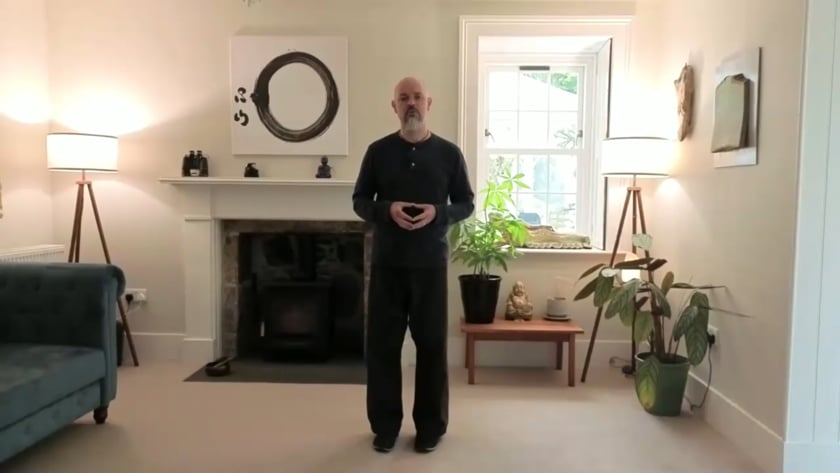
And as we stood there this morning, it seemed to me that one of the things changing was attention.
There was less need to know what was happening.
Less need to understand it.
And, without really doing anything at all, a little less holding.
This took me towards something we will be exploring later this month in our Unholding circle. What do I actually mean by unholding? Is it just another word for letting go?
I'm not sure it is.
Years ago, in a class in London, Anthony said to me, “Letting go is hard.”
It was one of those little comments that stayed with me, because there is something rather interesting in it. We can try very hard to let go. We can notice something we are holding onto and decide that we shouldn't be holding it anymore. Then another part of us gets involved and starts trying to make the letting go happen.
Have I let go yet?
What do I need to do to let go?
What happens if I do?
And the very part of us that wants to let go may be the part that still wants to hold on, because it needs to know what will happen next.
So unholding feels slightly different.
Not something we do to ourselves, but something that happens when, for whatever reason, we no longer need to grip quite so tightly.
And standing in Wuji allows us to notice that.
We don't have to get rid of thought. We can think about our day quite easily while standing there. We can analyse the practice. We can wonder whether our posture is right, whether our breathing is right, whether we are relaxed enough. We can probably think about what we're having for lunch at the same time.
But then something changes.
We enter.
And it was around here in the class that something else came to me.
Wu Wei.
Sometimes we talk about Wu Wei as non-doing, or even undoing, but I'm not sure that language quite grasps it for me anymore. Because undoing still sounds as though there is something I have to undo.
Maybe nothing needs undoing.
It is simply not doing what we were doing before.
There is less need to grasp.
Less need to know.
Less need even to understand what is happening.
And that feels closer to unholding for me.
Not opening the hand because I have told the hand it must open, but noticing that it is no longer closed.
There is a difference there, although I'm not sure it needs too much explaining. In fact, explaining it too much probably takes us straight back into the very thing we are exploring.
There is nothing really to get in Wuji.
We can let the experience be enough.
And then we smile from the heart.
Even that is interesting.
Because smiling from the heart can very easily become another instruction. Smile. Be happy. Be open. Feel love. And suddenly we are standing there with something that looks more like a grimace because we are trying very hard to look as though we are not trying.
That isn't quite it either.
Smiling from the heart seems to arrive.
We could say it comes from a place of love. I think it does. But I'm not sure I can measure that or prove it, and I don't particularly need to.
There is a quality to it that we know.
And that is enough.
This is where the practice begins to teach us something that words struggle with. We can talk about a Qigong state of mind, Wu Wei, relaxation, unholding, smiling from the heart, but eventually we have to enter the experience.
Otherwise we are just talking about it.
So we began to move.
We came into Lift the Sky, a pattern many of us have practised thousands of times, and I became interested in what attention was doing within the movement.
There is a focus as the hands rise. There is an awareness of the palms, the movement, the body connected as a whole, and then as we come upright and the arms begin to descend, something spreads.
The attention spreads.
The awareness spreads.
You don't really have to think about how the arms are going to get from the top to the bottom. They seem quite capable of doing that themselves.
And there is this lovely absence of unnecessary effort.
Not an absence of effort altogether. We are standing. We are moving. Muscles are working. Attention is present.
But only the effort that is needed.
And as the qi begins to flow and the body is allowed to move, even the need to manage the movement begins to soften.
We go with the flow.
That is another phrase we can say very easily, of course. “Go with the flow.” It can become one of those things that sounds good on a mug.
But in Qigong we can actually experience it.
There is movement, and then what looks like a pause, but even in the pause there is movement. There is stillness within movement and movement within stillness.
Again, that can sound like a clever Taoist quote.
But when you're standing there and you can feel it, it doesn't need to be clever.
It is simply what is happening.
And the quality of attention that allows us to notice it seems to come from some of that absence of unnecessary effort.
There is an openness without needing to open anything.
We simply aren't gripping or closing quite so much.
I want to be careful here, because gripping and closing and thinking and analysing and measuring aren't bad things. We need them. I certainly wouldn't want to drive home from class in some wonderfully expansive state in which I had decided that focusing on the road was an unnecessary form of attachment.
There is a time to focus.
There is a time to measure.
There is a time to work something out.
What we are exploring is the ability to move between these different ways of attending, rather than becoming caught in only one of them.
And Shooting Arrows made that much clearer.
Here we deliberately brought the attention to a single point, the fingertip of the extended hand.
There is quite a precise focus there, but we explored whether it was possible to have that focus without unnecessary tension.
Not concentrating.
Focusing.
I'm aware that those words may sound as though they mean the same thing, but they didn't feel the same in the practice.
There was a quality of arriving at the fingertip without contracting everything else around it.
And then the arms released and awareness broadened again.
Then back to the fingertip.
Then the whole.
And as we repeated the pattern, it occurred to me how often this happens the other way around in ordinary life.
Something happens.
Someone says something.
There is a problem, a person, an event, a worry, something we have forgotten to do, something we think might happen next week, and our attention becomes incredibly focused on that one thing.
Sometimes we need that. If something needs sorting out, it needs sorting out.
But we can also become so focused on the part that we lose our awareness of the whole.
And that seemed to be what Shooting Arrows was allowing us to play with.
We could arrive at the fingertip completely.
And then leave.
Broaden.
Return.
Not because the fingertip was wrong and the whole was right, but because both ways of attending are available to us.
There was something of the rhythm we have been exploring recently in that too: arriving, entering, pausing, leaving, returning.
Except it didn't feel like a sequence we had to remember.
It was happening within the movement.
We arrive at the fingertip. We return to the whole. We arrive somewhere else. We leave again.
There is a rhythm to it.
And I wonder whether this is part of what gets lost when we become stuck in something. We haven't become focused because focusing is a problem. We may simply have forgotten that attention can move again.
That it can return.
Then we came into Plucking Stars, and something else happened.
With Lift the Sky there had been this sense of up and down, focus and release. With Shooting Arrows, a single point and then the broader field.
But in Plucking Stars one hand is above while the other is below.
We are, in a way, in two places at the same time.
Awareness doesn't necessarily have to choose.
There is above and below.
Gathering and spreading.
We return to holding the ball and gather again, then spread.
And as we played with it, the movement became freer. The hands began to go where the hands went. For some people there was a very tangible sense of energy between them, expanding and contracting, becoming bigger and smaller.
I suggested that the sphere might spread all the way out into the cosmos.
Which sounds slightly ridiculous when I write it down.
But there we are.
Qigong can be like that.
And if that isn't someone's experience, it doesn't matter. We can play with the movement. We can imagine the energy. We can notice whatever is actually there.
Again, nothing to prove.
Nothing particular that has to happen.
Let the experience be enough.
What came to me in that moment was this possibility that our awareness can include what at first seems to be different things.
We don't necessarily have to choose between the part and the whole.
Or between focus and openness.
Or even, perhaps, between holding and unholding.
They are in relationship.
That has become increasingly important to me about unholding. I don't want holding to become the thing we need to get rid of.
We hold for reasons.
Sometimes holding is useful. Sometimes it has protected us. Sometimes it is exactly what a situation requires.
The invitation isn't to become someone who no longer holds. It is to notice the relationship.
To notice when holding is needed, and when it isn't anymore.
And somewhere in all of this, I think Qigong has been teaching us that for years, long before I started using the word unholding.
We focus and release.
Gather and spread.
Move and become still.
Leave and return.
There is no argument between these things.
There is movement between them.
By the end of the class we had returned to Wuji again, flowingly still, and it occurred to me how easily all of this could disappear again once we returned to the rest of Friday.
Because life will take over.
It should.
There are things to organise and people to speak to and jobs that need doing. We will become focused again. We will think and plan and analyse and worry a bit. We will lose that spaciousness.
And then there can be these little moments of returning.
Not twenty minutes of practice necessarily.
Maybe we walk outside for a minute.
Maybe there is a moment standing at the kettle.
Maybe we notice that we have become very small around one particular problem and, just for a moment, remember the rest of the body, the breath, the space around us, the ground underneath us.
The whole.
Not to make that a thing either.
I don't want returning to become another chore.
Something else we are supposed to remember to do because it is good for us.
With practice it becomes increasingly familiar, in the same way that standing in Wuji has become familiar. Something in us recognises the way home.
We return to that spaciousness.
We smile from the heart.
We return to centre.
And then we carry on.
As I sit with the class now, I think that may be what interested me most about those thirty minutes. We didn't really learn anything new. Lift the Sky, Shooting Arrows and Plucking Stars are old friends. Wuji is where we have stood together countless times.
What changed was the way we met them.
And maybe that is why, after years of practice, we can return to something apparently simple and find that it isn't quite the same practice anymore.
Because we aren't quite the same either.
So entering a Qigong state of mind isn't what we think.
I'm not even sure it is somewhere we enter.
It may be closer to remembering what it feels like when we are no longer holding quite so tightly to one small part of ourselves.
When the part can still be there, but the whole hasn't disappeared.
And then, when we inevitably lose ourselves again, as we all do, there is the possibility of returning.
Not forcing.
Not fixing.
Just returning.
Still the Student
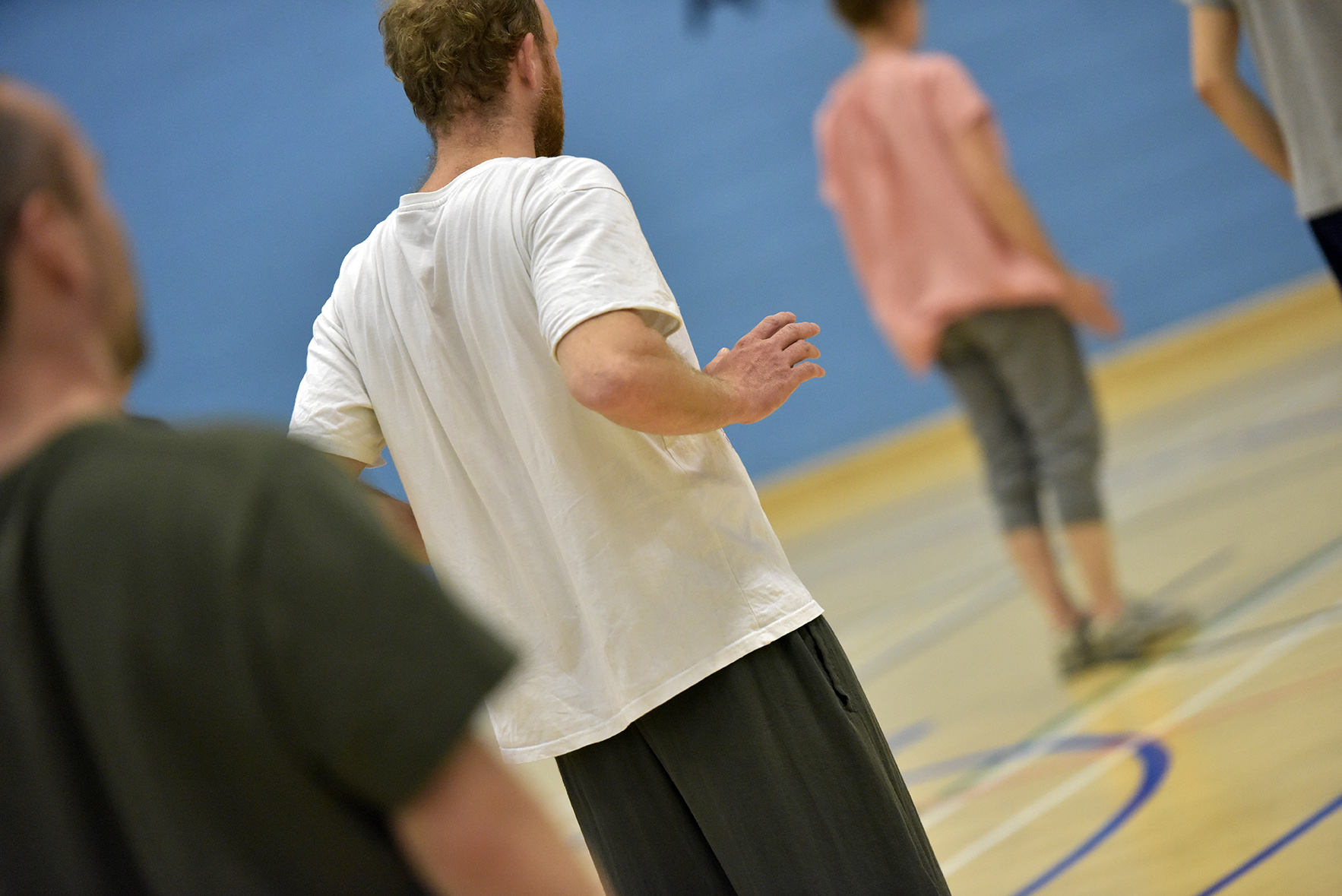
Still the Student
My Sifu taught me far more than I could ever realistically practise.
I was thinking about this during this morning's Qigong class.
Whenever I trained with Grandmaster Wong Kiew Kit, there were always more practices, skills and ways of exploring than I could possibly take away and train deeply at one time.
So I didn't try.
I would sometimes take one thing that had particularly caught my attention and spend the next year exploring it. Not simply repeating the technique, but practising it, experiencing it and gradually discovering what was there.
Over the years this gave me a broad training, but it also gave me something else. It taught me that we don't necessarily understand a teaching when we first receive it.
Sometimes we need to live with it.
Coming full circle
My training has always seemed to move in circles.
I return to the foundations. Then something takes me a little deeper. Something else catches my attention and I follow that for a while. Eventually I find myself returning again to something I thought I already knew.
But of course, I am not the same person returning.
Recently, internal force has been calling me back.
I don't really know why.
And perhaps that is part of what has changed in me too. I don't feel such a need to know why.
For much of this last year I have increasingly approached my practice as an explorer rather than as the person who knows what is supposed to happen.
There are foundations I trust. Skills that Sifu gave us. Principles that have guided decades of practice.
But beyond that, there is an enormous landscape still to discover.
Perhaps that is one of the gifts of practising an art for a long time. You can come back to where you started and discover something you couldn't see before.
Returning to internal force
When I first encountered internal force training, it immediately grabbed my attention.
I had spent many years practising martial arts and I was searching for something I felt was missing.
Internal force seemed to be it.
And in one sense, it was.
I discovered that it was possible to develop considerable force without relying upon muscular strength and tension. But I also began discovering things I hadn't been looking for.
I had more energy.
My mind became clearer.
There was a groundedness and stability that came from the training. And there was another dimension to it that was much harder to describe, where physical training, energy and spiritual cultivation no longer seemed quite so separate.
Back then, having more energy mostly meant that I could do more.
And I did.
A lot more.
Looking back from where I am now, that makes me smile.
Because as internal force has begun calling me back again, I find myself approaching it with a different question.
I'm less interested in how much energy I can develop.
I'm interested in what happens when that energy becomes something we can rest within.
Strength without holding
There was a moment in this morning's practice when this became particularly clear to me.
We had been practising Pushing Mountains and Separating Water, cultivating internal force through the arms and palms before returning to stillness.
I found myself saying:
We're not holding ourselves, but any position that becomes held gets held by the energy, the force that you've built.
That stayed with me.
Because so much of my exploration recently has been around holding and unholding.
We often associate strength with our ability to hold.
Hold our posture.
Hold ourselves together.
Hold our emotions.
Hold our ground.
Keep going.
Perhaps there is another kind of strength.
One that doesn't require us to continually brace ourselves in order to remain steady.
In internal force training, what can look quite powerful from the outside can feel remarkably soft from within. The body isn't limp, but neither does it need to become unnecessarily tense.
There is structure, but less effort.
Strength, but less forcefulness.
Perhaps even resilience without quite so much holding.
What kind of resilience?
Towards the end of this morning's class, a student, Kate, asked a lovely question.
Could cultivating internal force ultimately be cultivating resilience? Physical resilience, emotional resilience and spiritual resilience?
I think it can.
But my understanding of resilience has changed too.
There was a time when resilience meant that I could withstand more. I could hold steady when things became difficult. I could keep going.
There is undoubtedly value in that.
But sometimes even resilience can become another form of holding.
We become very good at holding ourselves together.
What I am becoming more interested in now is whether there is a resilience that doesn't require quite so much effort.
A steadiness that comes from being grounded enough to meet what is happening.
To feel an emotion without immediately needing to escape it.
To experience uncertainty without immediately having to resolve it.
To wobble without assuming something has gone wrong.
To trust ourselves enough to remain present.
Perhaps internal force isn't simply about having more energy.
Perhaps it is also about how we inhabit ourselves.
Still learning
This is where I find myself returning to Sifu.
There are things he taught me many years ago that I thought I understood.
And perhaps I did understand them, as the person I was then.
Now I sometimes return to one of those teachings and something else reveals itself.
During the class this morning I imagined Sifu looking at me with that familiar smile and saying:
So... you're ready to hear it now?
And probably having a little chuckle.
There are moments in practice when something suddenly becomes obvious and I find myself thinking:
Ah.
That's what you meant.
Thank you.
More than three decades into this journey, I find that rather comforting.
Still the student.
Still practising.
Still discovering.
And still occasionally coming full circle, only to realise that the circle has brought me somewhere new.
Cultivating Internal Force
This September I am beginning a new Monday evening class exploring the cultivation of internal force.
We'll be returning to some of the practices that have accompanied me for many years: stance training, Qigong, breath, mind, stillness and the traditional methods through which internal force is developed.
But I don't want this to be simply a collection of techniques.
I want us to explore.
To practise deeply enough that the practices themselves have an opportunity to reveal something.
Because perhaps the most interesting question isn't:
What am I supposed to get from this?
But:
What might I discover if I stay with it?