Sifu’s Three Golden Rules: A Reflection
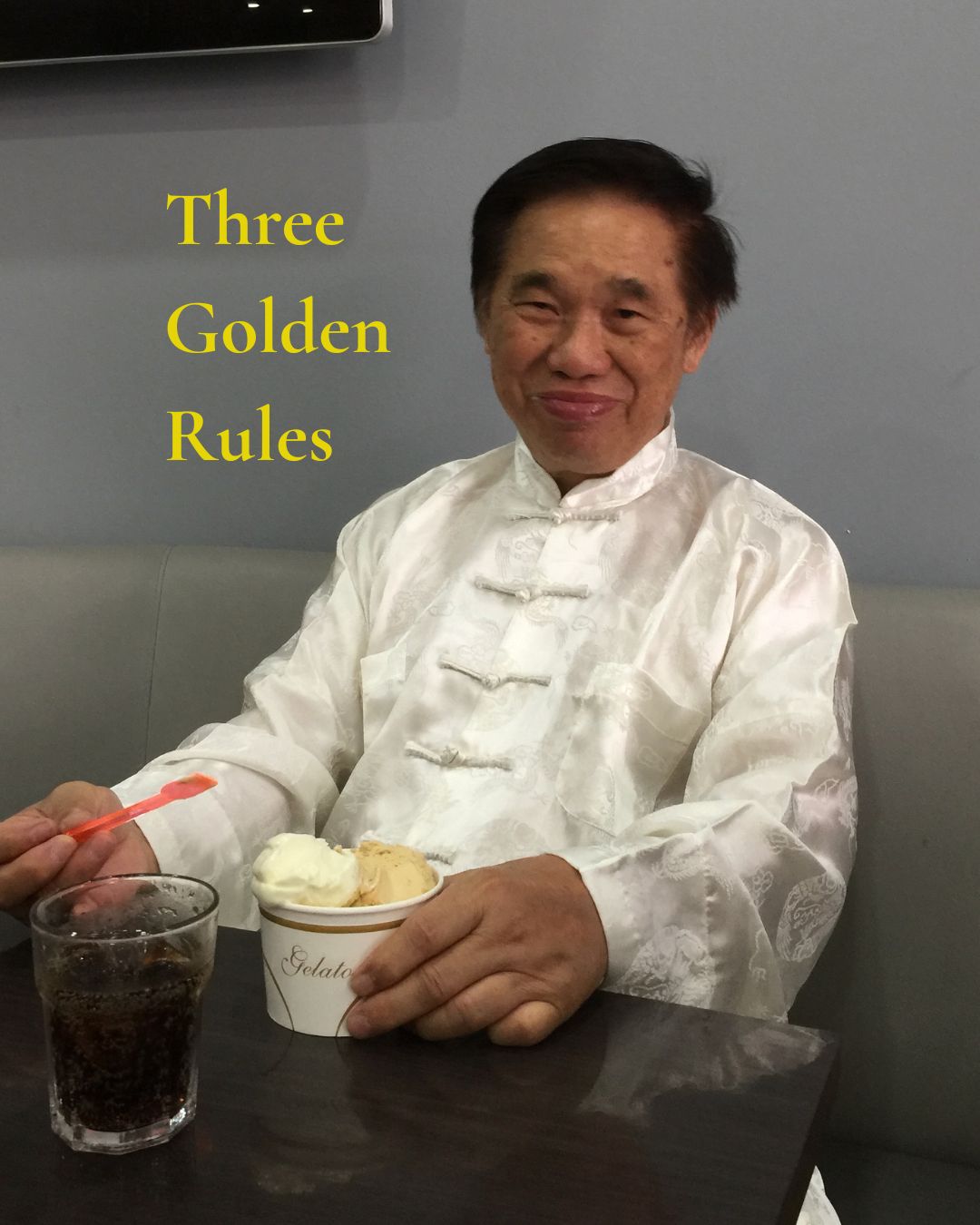
Sifu's Three Golden Rules: A Reflection
Breathing, rhythm and the way we meet the moment
By Tim Franklin | November 2026
With 1 December approaching, the anniversary of Sifu's birth, I've found myself reflecting on some of the simplest and most valuable teachings he shared with us.
Among these were his Three Golden Rules of Practice:
Don't Worry. Don't Intellectualise. Enjoy Your Practice.
Sifu, Grandmaster Wong Kiew Kit, explained that these rules arose from his observations over many years of teaching, particularly when helping students overcome difficulties in their practice (Wong, 2014).
He also taught another set of three golden rules, particularly in relation to stance training and developing internal force:
Relax. Relax. Relax. (Wong, 2007).
Over the years, I've often brought these teachings together in my own classes, sometimes reminding students simply to:
Relax. Don't Worry. Enjoy Your Practice.
They sound wonderfully simple, don't they?
And yet, after all these years of practising and teaching the Shaolin Arts, I continue to discover just how much there is to explore within them.
One of the things I've always appreciated about Sifu's teaching is that these principles weren't confined to our Qigong practice.
In answering a question about taking on a new management role, Sifu recommended applying the three golden rules to the experience (Wong, 2012). In the same collection of answers, he also spoke about being focused and relaxed at the same time, and how the benefits of training can extend into family life.
I find that particularly interesting because it speaks to something I've been exploring more deeply in my own practice and teaching: how the qualities we cultivate through the Shaolin Arts influence the way we meet the ordinary experiences of living.
Our recent Friday morning Qigong class brought this home to me again. We were exploring breathing, and how something as natural as breathing can change when we begin paying attention to it.
What interested me wasn't simply whether we were breathing more slowly or deeply, but what happened when we began observing, measuring or trying to influence something that ordinarily takes care of itself.
And once again, I found myself returning to Sifu's teachings.
When we begin paying attention to breathing
At the beginning of the class, I invited everyone to notice their breathing.
Nothing particularly complicated. Just noticing how many breaths they were taking in a minute.
Of course, something rather interesting can happen when we do this.
The very act of observing our breathing can change it.
For some people, paying attention to the breath is relaxing. The breathing slows, the body begins to settle and the mind becomes quieter.
For others, the opposite can happen. They become conscious of how they're breathing and begin wondering whether they're doing it correctly.
Should I breathe more deeply?
Am I breathing too quickly?
Should the inhalation and exhalation be the same length?
And before long, something that was happening quite naturally has become another activity to manage.
I recognise this in my own experience too.
There's a difference between becoming aware of my breathing and beginning to organise it. Sometimes the distinction is quite subtle. I can be observing the breath and then, almost without noticing, find myself encouraging it to become slower or more regular.
This is where Sifu's instruction, Don't Worry, becomes particularly useful.
Not as another instruction that we must successfully carry out, but as a reminder to notice whether worry has entered our practice.
And then there's Don't Intellectualise.
Sifu wasn't suggesting that we should never think about or investigate our practice. He wrote specifically about the difficulties that can arise when unnecessary intellectual activity interferes with the experience of Qigong (Wong, 2014).
We can become so interested in understanding what's happening that we begin to lose contact with the experience itself.
I find that fascinating.
Especially because I'm someone who enjoys exploring how things work.
Breathing, rhythm and our changing state
Over the years, I've become increasingly interested in how our breathing relates to our state of mind and the way we feel.
Sometimes, when we're relaxed, the breathing becomes slower and more settled without any deliberate attempt to change it.
I've noticed this in my own Qigong practice. As I enter a deeper state of relaxation, my breathing can become very slow, occasionally around six breaths per minute or even fewer.
I don't regard this as an achievement or something to aim for. It's simply an observation of what sometimes happens during my practice.
If I deliberately try to reproduce that breathing rate, I may introduce effort that wasn't present when the change happened naturally.
But breathing can also be something we work with more deliberately.
There are times when a longer, relaxed out-breath may help us settle, encouraging a quieter, calmer state.
At other times, a more dynamic breathing pattern can feel stimulating, bringing a sense of alertness, clarity and energy.
And sometimes we may find a more balanced rhythm, with the inhalation and exhalation of approximately equal length, that feels comfortable and steady.
We might describe these different qualities as down-regulating, up-regulating and balancing.
I find it useful to recognise that we don't always need the same thing.
There are occasions when we need to settle, others when we need more energy, and times when we simply want to remain balanced and responsive to what's happening.
Of course, these aren't rigid categories. Our breathing and our state of mind influence one another, and the relationship can change from moment to moment.
What interests me is how we can explore these relationships through Qigong, and how the experience might help us recognise what we need in everyday life.
Lifting the Sky and the rhythm of movement
After our initial exploration of breathing, we entered a Qigong state of mind and practised Lifting the Sky.
It's an exercise many of my students have practised hundreds, if not thousands, of times.
And yet, I continue to find new things to explore within it.
One of the areas we've been curious about recently is the relationship between breathing and movement. There are several ways we can explore this. For example:
- Do we allow the movement to follow the breath?
- Or the breath to follow the movement?
- Or allow both movement and breath to follow the flow of energy?
At first, these might seem like small distinctions. But as we begin exploring them, we can discover how our attention influences the experience.
If I deliberately organise my breathing, the movement may begin to accommodate the rhythm I've chosen.
If I allow the movement to unfold more naturally, I may notice the breathing finding its own relationship with it.
And when I allow both movement and breath to follow the flow of energy, I may discover something different again.
There are times when a particular breathing pattern is part of the technique we're practising, and learning that technique correctly is important.
But once we've developed the necessary skills, there can also be opportunities to explore the relationship more deeply.
And this is where I find myself returning to Sifu's three golden rules.
Don't Worry. Don't Intellectualise. Enjoy Your Practice.
I can become so interested in coordinating my breathing and movement that I begin introducing unnecessary effort. I might notice my shoulders tightening, or find myself anticipating the next breath rather than experiencing the movement that's happening now.
And when I recognise this, I can return to another of Sifu's reminders:
Relax. Relax. Relax.
What's interesting is that even relaxation can become something we try to achieve. We notice tension and immediately begin trying to get rid of it. And sometimes, in doing so, we introduce a little more.
I've found it useful simply to recognise what's happening and allow myself to continue exploring.
What happens when I stop worrying about whether the breath and movement are perfectly coordinated?
What happens when I become less occupied with explaining the experience and allow myself to enjoy it?
Sometimes the breathing settles. Sometimes the movement becomes easier. And sometimes I notice something I hadn't expected.
There's a wonderful freedom in being able to explore these differences without needing every experience to confirm what I already know.
And that, for me, is part of the enjoyment of practice.
Shooting Arrows and the musician's breath
Later in the class, we explored Shooting Arrows, another of the 18 Lohan Hands.
This led to an interesting conversation with Jonathan, a long-standing student who also has considerable experience as a musician.
He described how, through his musical training, he'd developed a breathing rhythm involving a relatively quick, relaxed inhalation followed by a longer, controlled exhalation.
That made complete sense in the context of playing a wind instrument or singing, where much of the activity takes place during the out-breath.
My own experience through Qigong has been rather different.
Over time, I've found that my breathing can become very slow, with the inhalation and exhalation often feeling more balanced.
During Shooting Arrows, these different experiences became noticeable.
What felt natural to me wasn't necessarily what felt natural to Jonathan.
And what felt natural to him was informed by many years of training and experience.
Neither of us needed to be wrong.
We were encountering the same exercise through different histories, different skills and different relationships with breathing.
Jonathan offered an observation that stayed with me: the breath fits the mood.
I rather liked that.
It also brought me back to our earlier exploration of breathing and how different rhythms can influence our experience.
In Qigong, some breathing patterns, particularly those involving a longer, relaxed out-breath, may encourage us to settle.
Other patterns can feel more energising.
Shooting Arrows is an interesting example. When we practise its special breathing technique, with the ssshhh sound followed by haa as we release, we can experience greater clarity of mind, focus and energy.
And there are times when a slower, more balanced breathing rhythm feels particularly natural and comfortable.
What I find interesting is that we can encounter these different qualities through our practice without needing to decide that one is always better than another.
There are times in everyday life when we need to settle, perhaps after a difficult experience or when we've become caught up in worry.
There are other times when we need to bring more energy and focus to what we're doing.
And there are times when we feel balanced, able to respond to what's happening without becoming either overly agitated or withdrawn.
Through practice, we can become more familiar with these qualities and begin recognising them beyond the exercise itself.
And this brings me back to Sifu's three golden rules.
Don't Worry. Don't Intellectualise. Enjoy Your Practice.
What I find interesting is how easily our attention can shift from being engaged in what we're doing to becoming concerned about how well we're doing it.
In Shooting Arrows, we cultivate clarity, focus and energy. Yet if I become too preoccupied with whether I'm getting everything right, I can lose some of that natural clarity and focus.
And I recognise this in everyday life too.
I might be working on something I enjoy, but become so concerned with improving it that the enjoyment gradually disappears.
It's quite remarkable how easily this can happen, even when we know better!
Sometimes, simply recognising what's happening allows me to return to what I'm doing with a little more ease.
Bringing the golden rules into everyday life
One of the things I've become increasingly interested in is how the qualities we cultivate through Qigong can become available to us throughout the day.
The breathing explorations offer a useful example.
Sometimes, when I'm feeling unsettled, I notice that my breathing has become quicker or shallower.
At other times, when I'm deeply engaged in something, my breathing may settle into a comfortable rhythm without my having paid any particular attention to it.
And when I'm tired or struggling to concentrate, I may recognise that I need to become a little more alert and energised.
There can be value in recognising these different states.
But I've also noticed that our responses to them can sometimes make things more difficult.
We feel worried, and then begin worrying about being worried.
We notice tension, and immediately become concerned about how to relax.
Or we feel tired and begin criticising ourselves for not having enough energy.
It's quite easy to add another layer to whatever we're already experiencing.
This is where I find Sifu's golden rules particularly helpful.
Don't Worry reminds me that I don't need to make every experience into a problem.
Don't Intellectualise reminds me that there are times when thinking more about something isn't necessarily going to help.
And Enjoy Your Practice encourages me to remain engaged with the experience rather than becoming entirely occupied with what I hope to achieve.
I find these reminders useful in conversations too.
There are times when someone shares something difficult and I notice an urge to respond, explain or offer a solution.
Sometimes a response is helpful.
But sometimes, simply remaining present and listening allows something else to happen.
And I can recognise the same tendency in myself when I encounter an uncomfortable feeling.
I might notice frustration, sadness or uncertainty and immediately begin looking for a way to change it.
What happens if I allow myself a little more room to recognise what's happening before deciding what to do?
Can I remain with the experience without immediately trying to improve it?
These are questions I continue to explore, both through my practice and through my work with others.
And there are times when a little more energy or focus is exactly what's needed.
Perhaps I have something important to attend to, a difficult task to complete or a conversation that requires my full attention.
The qualities cultivated through Qigong can become useful here too.
Being relaxed doesn't mean we have to become passive or sleepy.
We can be alert and focused while remaining at ease.
I remember Sifu speaking about being focused and relaxed at the same time (Wong, 2012).
That combination continues to interest me.
Sometimes I need to settle.
Sometimes I need to bring more energy to what I'm doing.
And sometimes I recognise that I'm already in a comfortable balance, and there's very little I need to change.
The golden rules help me meet these different experiences without becoming unnecessarily caught up in them.
Returning to something familiar
I sometimes think that one of the difficulties with becoming experienced in a practice is that we can begin to assume we know it.
We've practised Lifting the Sky for years.
We understand the technique.
We know the benefits.
And there is tremendous value in that accumulated experience.
But familiarity can also bring expectations.
We may begin to anticipate what should happen before we've allowed ourselves to discover what is actually happening.
That's been one of the delights of returning to the first few Lohan Hands this year.
Exercises I learned many years ago continue to offer opportunities to explore breathing, movement, stillness and the way I meet my experience.
And sometimes the discoveries are very small.
A little less effort in the shoulders.
A moment when the breathing settles without being managed.
Recognising that I've become caught up in trying to achieve something.
Or listening to a student describe an experience quite different from my own.
These moments continue to interest me.
They also remind me why Sifu's teachings have remained so valuable in my life.
Returning to stillness
As Sifu's birthday approaches, I find myself returning to those simple teachings he shared with us.
Don't Worry. Don't Intellectualise. Enjoy Your Practice.
And, of course:
Relax. Relax. Relax.
After all these years, I still find myself discovering something new within them.
Sometimes through a familiar exercise, sometimes through a conversation with a student, and sometimes in the most ordinary moments of everyday life.
I think of Sifu, and the many occasions when his teachings brought us back to something so simple that we might easily have overlooked it.
And I smile.
Tomorrow morning, when I practise Lifting the Sky, I'll begin as I always do.
Standing quietly in Wuji.
Allowing myself to settle.
And seeing what unfolds.
References
Wong, K.K. (2007) ‘The Secret of the Internal Force Masters’, Wahnam Taijiquan, Blue Mountain, January 2007, Part 1. Available at: https://shaolin.org/video-clips-3/blue-mountain2007/taijiquan01.html (Accessed: 2 November 2026).
Wong, K.K. (2012) ‘Selection of Questions and Answers, May 2012, Part 1’, Shaolin Wahnam Institute. Available at: https://shaolin.org/answers/ans12a/may12-1.html (Accessed: 2 November 2026).
Wong, K.K. (2014) ‘The Three Golden Rules of Practice’, Shaolin Wahnam Institute, originally published in Questions and Answers, March 2014, Part 3. Available at: https://shaolin.org/answers/sp-issues/ansur02.html (Accessed: 2 November 2026).