Why Do We Brace Ourselves?
What a simple Qigong exercise revealed about tension, trust, and the habit of holding
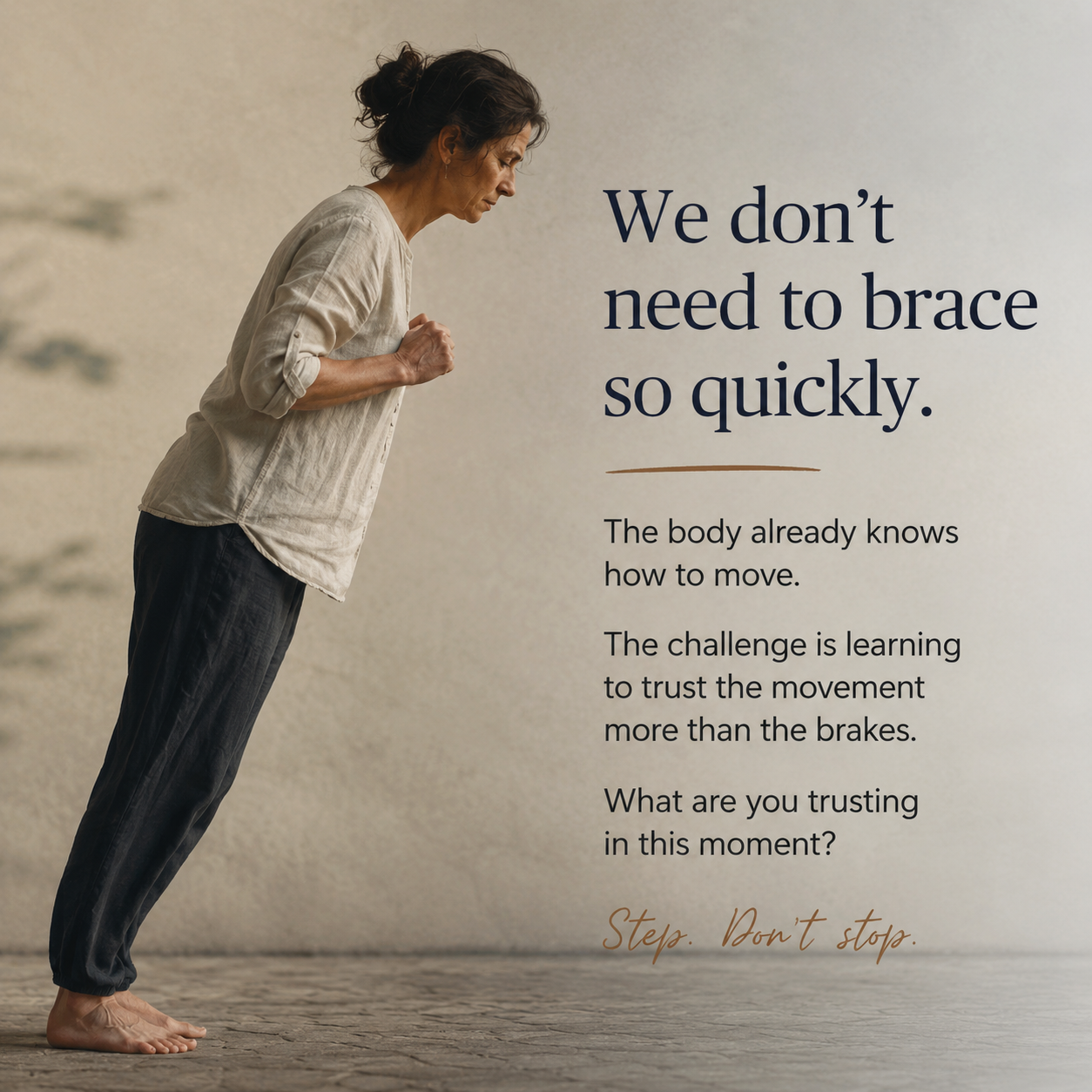
This morning in Qigong class, we were exploring a simple exercise.
Standing upright, we gently leaned forwards onto our toes and backwards onto our heels. As the body moved forwards, there came a point where a step was needed. As it moved backwards, the same thing happened. Simple enough. Yet what interested me wasn't the step itself. It was everything that happened just before it.
For some of the newer students, there was a moment where the body seemed to put the brakes on. Rather than allowing the movement to continue naturally into a step, the shoulders tightened a little, the legs stiffened, and the body began trying to stop itself. Nobody was doing anything wrong. In fact, they were discovering something important.
The body already knew how to step forwards.
The body already knew how to step backwards.
The difficulty wasn't learning the movement.
The difficulty was trusting it.
One student shared something else that was equally interesting. As the exercise continued, they became more aware of tension in their legs and lower back.
For many people, this can be confusing. If the exercise is helping, shouldn't everything feel easier?
Shouldn't the tension disappear?
Yet often the opposite happens at first. Not because the practice is creating tension, but because it is revealing it. The tension was already there. The effort was already there. The body had simply become so accustomed to it that it no longer stood out.
When the body begins to align, and unnecessary effort starts to soften, those habitual patterns often become easier to feel.
What was hidden in plain sight becomes visible. I have seen this happen countless times over the years.
Someone begins meditation and discovers how busy their mind has been.
Someone slows down and realises how tired they are.
Someone starts counselling and becomes aware of feelings they had been carrying for years.
The practice doesn't create the experience.
It reveals what has quietly become normal.
One of the things I have always appreciated about Qigong is how often it reflects everyday life. This morning's exercise was no different. The students weren't really learning how to move forwards or backwards. Most of us mastered that years ago. What they were discovering was the habit of putting the brakes on.
The habit of tightening when tightening wasn't needed.
The habit of trusting the holding more than the movement.
And once you see it in the body, it becomes surprisingly easy to recognise elsewhere.
A difficult conversation approaches, and we tense.
An uncomfortable feeling arises, and we tense.
Something uncertain appears on the horizon, and we tense.
Not because there is anything wrong with us.
Because the holding feels familiar.
Over time, many of us learn to trust it.
We trust the tension more than the relaxation.
We trust the efforting more than the non-efforting.
We trust the holding more than the letting go.
The strange thing is that these habits were usually learned for good reasons. At some point, they helped us. They protected us. They helped us navigate uncertainty and avoid mistakes. They may even have helped us feel accepted and safe. Yet what serves us in one moment can quietly become our response to every moment.
Eventually, we stop noticing it. The holding feels normal. The effort feels necessary. The brakes feel safer than the movement.
What I love about this simple exercise is that it offers another possibility. As the unnecessary tension begins to soften, the body remembers something it already knew.
It knows how to move.
It knows how to find balance.
It knows how to take the next step.
Nothing new needs to be added.
Something unnecessary simply begins to fall away.
Perhaps this is why practices like Qigong can be so revealing. They don't always teach us something new. Sometimes they remind us of something we have forgotten. This morning, the reminder was simple. The body already knew how to step.
The challenge was learning to trust the movement more than the brakes.
I suspect that is a lesson many of us continue to meet, both in practice and in life.